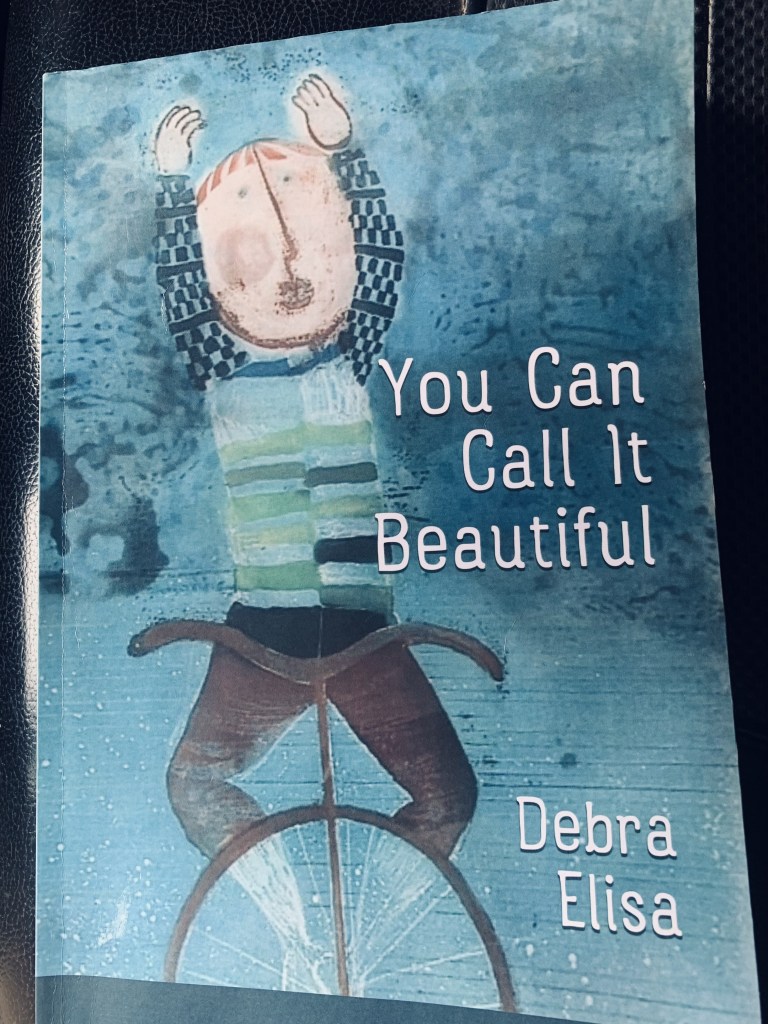
by Debra Elisa, MoonPath Press, 2023, 107 pp.
If you would like to listen to this review, please click below. I have done my best to pronounce Bolivian, Filipino, and Indian names.
Poetry Book Review: You Can Call It Beautiful
by Debra Elisa, MoonPath Press, 2023, 107 pp.
Reviewed by Sher Schwartz
Journeys Through Motion
Oregonian Debra Elisa’s first full length collection of poetry is a journey through motion whether exploring the movement of a changing heart or questioning friends about what it means to be a poet, Elisa’s intriguing collection considers inquiry into emotional, physical, and spiritual transformations. She writes: “How many truths need to be spoken,” “if only I’d known the boy would leap, “heat feeds the turtle/ in its own secret way,” and “you taught me the art/ of opening windows.” Each of these lines come from a poem in the four sections of the book, and each line entreats us to keep reading to discover insights and possible answers.
In “Dear Friend” the speaker asks: what is my poetry about––only to be surprised when the friend answers, “Trees…Dogs…Birds.” Doesn’t poetry “challenge us to consider justice/ and love in all sorts of ways?” Elisa’s work, in fact, does move us toward not forgetting the creatures and environments deserving to be cherished. She does this by slowing the reader down as we notice her use of white space and her innovative employment of capitalizations. In many of the poems animals, elements, and landforms are characters in the verse instead of simply being part of the description. In “Sprit Rise” Dog, Poppies, Wind, Petals, Fire, and Sun are characters moving the reader and the speaker toward the poem’s finale: ” I am awake.” An example from a portion of “Spirit Rise” shows Elisa’s use of capitalizations and how white space surrounds nouns to create emphasis for the creatures and environs we share the planet with. Elisa says pay attention:
I guide the Dog though she’ll never understand
how a speck so light a Poppy Seed
grows and leads me onward: Upright and brilliant
I see it now crimson and gold
Petals on Fire
when the Sun has shone enough
and I am awake
When the reader pays attention to the capitalized words, it becomes clear the entire poem can be distilled to an essence of Dog, Red and Gold Poppies, a Poppy Seed, Petals, Fire, Sun, and I am. The remaining narrative lyric is present, but with this distillation the reader becomes aware the poem’s components show reality as an inter-connected wholeness. The refinement process can be enacted by the reader in many of Elisa’s poems by noticing the words she has chosen to capitalize. The reader then takes an active role in a multi-layered experience moving beyond storyline toward metaphysics.
The second section of the book Boy on a Bicycle explores family relationships and secrets. Secrets ranging from a persona poem about Elisa’s grandmother and a tragic suicide of a young man, and an ekphrastic poem celebrating the beauty and pain surrounding a work of art. This painting The Winner by Graciela Rodo Boulanger, an 88 year old Bolivian artist, was given to Elisa’s mother by her father. Elisa recalls “it was the most beautiful work of art in our house.” Later, though, the painting was a painful reminder of a marriage that ended in bitter separation. Upon Elisa’s mother’s death, the painting passed to her, and it now hangs in her home and the image became the cover for this book.
“The Gecko & The Leaf” presents a dreamscape of missed opportunities coursing inevitably toward an ending that could not have been any other way:
that could have brought us together
long ago if only
we had not dreamt most
of losing ourselves
to the Moon.
They “wondered together,” but in the end they did not move together. Their Moon meant something different for each person, and I thought about how often my path has diverged from a friend’s.
Sprinkled throughout the collection are what poet Danusha Lamèris calls Wild Way poems. These poems witness nature, but the animals exist independently as they are not dependent on humans for relevance. In “Ode to Onward” Elisa shows us creatures tumbling, singing, preying, dying in traps, and animals choosing to move on:
I saw it all. Saw the Otter
tumble…
the saxophone boasting the blues
Bees singing in the Primrose
and Daffodil the ecstasy of forces…
The lone Wolf long slender legs
his narrow chest careens
through the Forest
seeking his prey….
Have you ever been hungry?
And there are Rats in my neighbor’s
basement dead in traps
and we know Rats can grow angry.
They can see what is happening
They don’t care who pays
the mortgage.
And finally, Elisa takes her readers to exotic locales she visits during her travels. In “Counting Palm Trees” we meet an unidentified observer in Siquijor, a small island in the Philippines: “from my window house on stilts I watch/ as the rich brother enters the hut next-door.” Each of the brothers “spar for their fair share of copra.” As we watch the villagers and feel their tensions we can imagine “ghosts” following everyone on the island including ourselves.
An entertaining and often humorous list poem “No” And Other Considerations––According to Mr. Chen” prepares a traveler to visit China:
Don’t be surprised at subtle groans
Remember you can never know who understands English…
If someone answers “yes” it can mean:
No.
I don’t know if that’s possible.
I don’t know what you said….
And the clever list continues until the reader receives a jolt of poignant information about the Three Gorge Dam on the Yangtze River.
“Varanasi Winter” presents an unforgettable portrait of missionary work in India: “The Sister calls me to bathe one/ shrunken Bone-thick woman.” The woman the speaker bathes has “fingers” like “Bird’s feet” yet she “fingers my muscle” and breathes a “silent prayer/ to hurt no one more.” I was immediately reminded of Mother Teresa’s compassionate work in India caring for the “poor, sick, and dying.”
Eventually the reader has crossed the world, explored family secrets in the Pacific Northwest, and noticed animals and landscapes in perhaps new ways. Debra Elisa spent her career teaching writing to others and helping students appreciate poetry. Her first book-length collection You Can Call It Beautiful is a brilliant tapestry of themes, and behind all the poems is a sense of motion and change both physical and spiritual.


 Sher Poetry


I love to receive your thoughts and comments about the poems you hear on Sher Poetry– please comment or like and let me know your response! Problems commenting? email voices@sherpoetry.com and your comments will be posted for you.